

Biopsy Devices Market to reach USD 3.65 Billion by 2035 at 4.30% CAGR
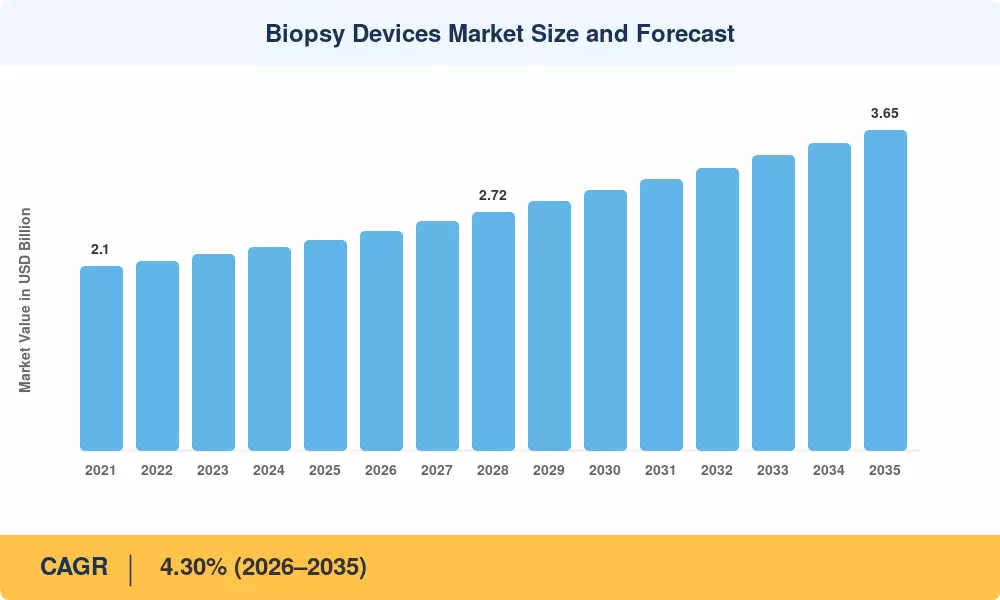
Biopsy Devices Market Size
Biopsy Devices Market to Grow from USD 2.50 Billion in 2026 to USD 3.65B by 2035-By Government-Funded Screening Mandates, AI-Integrated Image-Guidance Platforms
NY, CA, UNITED STATES, July 21, 2026 /EINPresswire.com/ -- As per Market Research Future, the global Biopsy Devices Market size to reach USD 3.65 Billion by 2035 from USD 2.50 Billion in 2026, at a CAGR of 4.30% during the forecast period 2026--2035. The market base was estimated at USD 2.40 Billion in 2025.The 4.30% CAGR---anchored by government-funded screening mandates rather than discretionary healthcare spending---is driven by three converging forces: rising global cancer incidence that continues to widen the addressable patient base for tissue confirmation procedures, sustained AI-integrated image-guidance platform expansion that has pulled biopsy procedures from freehand techniques into precision-navigation protocols, and ambulatory surgical center expansion that has converted complex biopsy workflows from inpatient cost centers into outpatient revenue drivers.
National governments and multilateral health organizations are amplifying this momentum. The International Agency for Research on Cancer predicts that by 2050, there will be 35 million new cancer cases per year, a 77% increase from 2022. Because at least one biopsy event is required for each confirmed diagnosis across over 90 nations with national cancer-control strategies, this demographic wave mechanically expands the addressable population for needle-based biopsy instruments and procedure trays.
Australia's 2025 launch of a bulk-billed low-dose CT lung-screening program is expected to generate an estimated 180,000 additional CT scans annually, with a projected 5--8% biopsy conversion rate. The EU's Beating Cancer Plan is allocating EUR 4 billion across member states. Together, these initiatives are creating the procurement infrastructure and delivery innovation on which the Biopsy Devices Market depends.
Request A Free Sample:
https://www.marketresearchfuture.com/sample_request/2250
Key Market Trends & Growth Drivers
Rising Global Cancer Incidence and Government-Funded Screening Mandates
The International Agency for Research on Cancer predicts that by 2050, there will be 35 million new cancer cases per year, a 77% increase from 2022. The three applications most dependent on tissue confirmation---breast, lung, and colorectal malignancies---account for around 38% of that total.
We find that at least one biopsy event is required for each confirmed diagnosis. This provides a structural demand floor that is mostly insensitive to economic fluctuations. Over 90 nations have national cancer-control strategies requiring pathology-confirmed staging prior to treatment commencement. This means epidemiological trends directly translate to device pull-through volumes.
Australia's 2025 launch of a bulk-billed low-dose CT lung-screening program for high-risk adults aged 50--70 is expected to generate an estimated 180,000 additional CT scans annually, with a projected 5--8% biopsy conversion rate. The U.S. Preventive Services Task Force expanded lung-screening eligibility in 2021 to include adults with a 20-pack-year history starting at age 50, widening the addressable population by roughly 6.5 million individuals.
These policy actions compress the timeline between screening detection and tissue sampling, accelerating device consumption across hospitals and imaging centers. National cancer registries in India and Brazil are also capturing higher detection rates as screening programs mature, feeding into the Biopsy Devices Market growth pipeline across emerging economies. Each percentage point of cancer incidence gain translates into measurable procedure volume for tissue confirmation, and the biopsy schedule embedded in routine oncology care makes this driver structurally durable through 2035.
AI-Integrated Image-Guidance Platforms
Legacy freehand needle techniques are giving way to integrated platforms that pair vacuum-assisted aspiration with AI-powered image guidance, cutting procedural time by an estimated 30--40% while improving specimen adequacy rates above 95%. Advanced biopsy systems now fuse real-time ultrasound, MRI, or CT imagery with machine-learning algorithms that calculate optimal needle trajectories and flag sampling adequacy in under two seconds.
Device manufacturers are embedding these algorithms directly into console software, creating a hardware-software bundling strategy that raises average selling prices by 15--22% per unit while improving clinical outcomes. Medtronic's 2024 launch of its AI-fused stereotactic platform and Hologic's acquisition of an automated specimen-verification startup underscore where capital is flowing. Regulatory bodies in the U.S. and EU have also streamlined 510(k) and CE-MDR pathways for single-use biopsy instruments, further lowering barriers to device innovation.
Real-time specimen verification reduces non-diagnostic rates from 8--12% to under 3%. Hospital procurement committees increasingly mandate this feature, favoring platforms from Hologic and BD that integrate verification imaging. AI-guided platforms require 15--25 supervised cases for operator proficiency certification.
Manufacturers are addressing this through simulation-based training modules that compress the learning curve to under one week. By 2035, autonomous biopsy navigation is projected to reduce operator-dependent variability by over 50%, expanding the pool of clinicians qualified to perform complex procedures. Machine-learning algorithms capable of real-time lesion segmentation and autonomous needle-path planning are expected to become standard features on mid-range and premium biopsy consoles by 2030.
Ambulatory Surgical Center Expansion and Value-Based Reimbursement
There were about 6,100 U.S. ambulatory surgical centers in 2024, with an average yearly net addition rate of over 200 centers. Now Medicare and commercial payors compensate outpatient breast and thyroid biopsies at rates similar to hospital outpatient departments, removing a long-standing economic barrier.
The channel shift is a direct positive for the Biopsy Devices Market, as ambulatory centers are purchasing proprietary single-use needle kits more frequently and with shorter replacement cycles than hospital-based reusable platforms. Medicare's 2024 ASC-approved CPT code expansion is the most consequential near-term catalyst. Commercial payors in the U.S. and private insurers in Germany are mirroring these codes, accelerating outpatient biopsy migration.
The move from inpatient to outpatient biopsy procedures---as seen with Medicare ASC reimbursement parity---decreases facility overhead from hospital outpatient department rates to ambulatory surgical center rates per procedure. Ambulatory surgical centers and community cancer clinics are seeing a rising preference for single-use kits due to lower operating costs and higher patient throughput. This convenience-driven adoption is expected to open up incremental revenue for the Biopsy Devices Market in the absence of complex inpatient infrastructure. Single-use devices eliminate reprocessing labor and sterilization costs, averaging USD 12--18 per cycle.
In facilities performing over 500 annual procedures, total cost of ownership for single-use models is roughly equivalent to reusable platforms within three years. China's county-level hospital upgrade program allocated ¥120 billion to diagnostic equipment procurement in its 14th Five-Year Plan. India's Ayushman Bharat scheme funded 182,879 new health-and-wellness centers in early 2026, with an additional 8,000 targeted through 2028. Together, these programs help make tissue confirmation procedures accessible to millions of previously underserved individuals.
Ask for Customization:
https://www.marketresearchfuture.com/ask_for_customize/2250
Market Segment Insights
BY PRODUCT TYPE
Needle-Based Biopsy Instruments: Dominant segment with ~47.5% revenue share in 2025. Reflecting entrenched physician familiarity with spring-loaded core systems in breast and liver applications.
Needle-based instruments dominate the Biopsy Devices Market because breast, lung, and liver biopsy guidelines uniformly specify either core or vacuum-assisted needle sampling as the standard-of-care first step. Spring-loaded automated core-needle devices account for the majority of unit volume within this segment, though vacuum-assisted systems are gaining share in breast applications due to superior specimen yield and lower re-biopsy rates. Hospital procurement teams treat it as a default first-line instrument, and standardized pricing has enabled broad adoption even in cost-sensitive emerging markets.
Procedure Trays: Fastest-growing product segment at 5.20% CAGR (2026--2035). Driven by hospital preference for pre-packaged sterile kits that reduce setup variability. Procedure trays are the fastest-growing product category by CAGR, reflecting the operational efficiency gains hospitals realize when consumables, drapes, and needles arrive pre-assembled in a single sterile package. The convergence of infection-control mandates with operational efficiency targets is creating bundled procurement platforms that personalize biopsy workflows at scale.
BY APPLICATION
Breast Biopsy: Dominant application with ~33.4% revenue share in 2025. Approximately one-third of all biopsy procedures are breast-related, making tissue confirmation a near-universal component of mammography-screening recall pathways. The inherent volume of organized population-based screening across OECD nations drives sustained dual-channel demand for stereotactic and ultrasound-guided needle systems.
Lung Biopsy: Fastest-growing application segment at 9.70% CAGR (2026--2035). Reflecting improved screening eligibility criteria that extend the window for tissue confirmation. Low-dose CT screening program expansion---the U.S. alone added an estimated 2.4 million eligible adults to its screening pool following the 2024 USPSTF guideline update---creates a larger prevalent population requiring sustained biopsy device utilization. Early-adopter health systems report that AI-enhanced CT platforms detect pulmonary nodules at subclinical stages, converting patients who would previously have presented with advanced disease into candidates for navigational bronchoscopy and CT-guided biopsy.
Colorectal Biopsy: USD 0.31 Billion in 2025. Colonoscopy-screening compliance improvement drives demand for endoscopic biopsy forceps and polypectomy devices.
BY GUIDANCE TECHNIQUE
Ultrasound-Guided Biopsy: Dominant technique with ~28.5% revenue share in 2025. Real-time visualization, portability, and absence of ionizing radiation make ultrasound the default first-line guidance modality for superficial lesions and breast tissue sampling. Hospital outpatient settings anchor this segment.
Stereotactic Guided Biopsy: Fastest-growing technique segment at 6.80% CAGR (2026--2035). Precision targeting of non-palpable breast lesions and small pulmonary nodules drives demand. Stereotactic systems enable tissue acquisition from lesions too small for palpation or ultrasound visualization, expanding the addressable biopsy population.
MRI-Guided Biopsy: USD 0.22 Billion in 2025. Superior soft-tissue contrast enables targeting of MRI-only visible lesions, particularly in prostate and breast applications. MRI-fusion platforms command premium pricing and drive higher per-procedure revenue.
BY END USER
Hospitals: Largest segment with ~63.4% share in 2025. Comprehensive imaging suites---MRI, CT, and stereotactic units---and complex image-guided procedure volume dominate revenue. Hospitals remain the primary delivery site for advanced biopsy procedures due to radiation safety infrastructure, specialized interventional radiology staffing, and licensing requirements for deep sedation.
Ambulatory Surgical Centers: Fastest-growing end-user segment at 9.90% CAGR (2026--2035). Outpatient shift and cost optimization drive demand as Medicare ASC reimbursement parity removes economic barriers to procedure migration. ASCs and community clinics increasingly prescribe single-use biopsy kits to manage inventory turnover and eliminate reprocessing liability.
Read Detailed Insights:
https://www.marketresearchfuture.com/reports/biopsy-devices-market-2250
Regional Outlook
North America -- Dominant Market (~44.1% Share, 2025)
The United States generates approximately 78.5% of North American Biopsy Devices Market revenue, driven by the USPSTF screening expansion, Medicare ASC reimbursement parity, commercial insurance coverage of vacuum-assisted and core-needle biopsy as standard-of-care tissue confirmation, and broad reimbursement for image-guided biopsy regimens---a single policy ecosystem that converted a hospital-dominated market into one with a structural outpatient tail.
Medicare's 2024 expansion of outpatient biopsy CPT codes to the ASC-approved list removed a key reimbursement barrier, and private payors have followed suit, creating a favorable economic environment for procedure migration out of hospital outpatient departments. CMS reimbursement for advanced guidance platforms under the hospital outpatient prospective payment system has driven adoption in academic medical centers, while community oncology networks increasingly prescribe single-use biopsy kits to manage inventory turnover. The US dominates through a combination of high per-procedure spending, robust payer coverage, and rapid AI-guidance adoption.
Europe -- Second Largest (USD 0.65 Billion, 2025)
Europe's Biopsy Devices Market reflects divergent national strategies---Germany leads regionally with DRG outpatient biopsy reimbursement expansion, contributing USD 0.16 Billion in 2025, while the UK historically used selective screening targeting before broadening coverage through NHS breast-screening age-range extension at 5.10% CAGR.
France contributes ~15.4% of regional share through Plan Cancer IV investment. Italy contributes USD 0.07 Billion on regional oncology network consolidation. Spain is growing at 4.40% CAGR on AECC early-detection campaigns.
Asia-Pacific -- Fastest-Growing Region (8.90% CAGR, 2026--2035)
Asia-Pacific is the engine of the Biopsy Devices Market. China holds the largest regional share with ~34.2% of regional revenue, driven by county-hospital diagnostic-equipment procurement---the 14th Five-Year Plan designated cancer early detection as a strategic public-health priority, allocating ¥120 billion to county-level hospital diagnostic upgrades.
India is growing at 9.50% CAGR on the back of Ayushman Bharat health-center expansion---the National Programme for Prevention and Control of Cancer targets biopsy-capable infrastructure in 600 district hospitals by 2028. Japan contributes USD 0.08 Billion through NHI pricing for MRI-guided biopsy at steady pace. South Korea is growing at 7.80% CAGR on NHIS reimbursement reform for advanced guidance platforms.
Middle East & Africa -- Emerging Opportunity (4.80% Share, 2025)
The Middle East & Africa is bifurcated between well-funded Gulf states and resource-constrained Sub-Saharan nations. Saudi Arabia leads the region with Vision 2030 healthcare investment at 6.30% CAGR, contributing ~28.6% of regional share---over USD 65 billion allocated to healthcare infrastructure, with diagnostic oncology identified as a priority vertical. The UAE is growing at 5.40% CAGR on medical tourism and private hospital expansion at USD 0.03 Billion in 2025. South Africa contributes USD 0.02 Billion on National Health Insurance rollout and university hospital upgrades.
Competitive Landscape and Recent Developments
The Biopsy Devices Market displays medium concentration, with the top five companies holding an estimated 48--55% combined revenue share. The Herfindahl-Hirschman Index sits in the 1,200--1,500 range, reflecting a mix of multinational medical device leaders and specialized interventional oncology developers. Patent expirations and generic entry are gradually fragmenting commoditized segments, though pipeline innovation in AI-guidance and robotic platforms sustains competitive moats for first-movers.
The competitive landscape is stratified between broad portfolio leaders serving global biopsy device markets, AI-fusion technology pioneers capturing premium navigation platform tenders, and value-segment specialists consolidating the standard needle segment.
KEY COMPANIES AND RECENT MILESTONES
Becton, Dickinson and Company (BD) (2024--2025): Maintains leadership with core-needle devices and biopsy site markers, commanding ~14--18% of global Biopsy Devices Market revenue. Broad portfolio leader with global distribution scale. Premium disposable positioning in specialty segments offsets generic price compression in competitive markets.
Hologic Inc. (2024--2025): Vacuum-assisted breast biopsy systems and automated specimen-verification technology reinforce the breast-health ecosystem integration positioning, holding ~12--16% of global revenue. First-mover in vacuum-assisted biopsy with global tissue confirmation leadership.
Medtronic plc (2024): Launched its AI-fused stereotactic platform, reinforcing the navigation-guided biopsy platform and AI-fusion technology pioneer positioning, holding ~7--10% of global revenue. The company benefits from the structural AI-guidance tail created by expanded platform investment.
Merit Medical Systems (2024--2025): Soft-tissue biopsy needles and procedure trays reinforce the value-segment positioning and OEM supply positioning, holding ~5--8% of global revenue.
Future Outlook: 2026--2035
By 2030, precision AI-guided biopsy theranostics will become the operating system of tissue confirmation management. The convergence of companion diagnostics and targeted navigation platforms will reshape the Biopsy Devices Market through the late 2020s. By 2030, an estimated 40% of newly diagnosed lung cancer patients will undergo LDCT screening followed by matched AI-navigated biopsy, creating a screening-diagnostic revenue loop.
Machine-learning models that integrate genomic, proteomic, and imaging biomarkers can recommend optimal guidance technique and needle selection for individual patients. Start-ups have raised over USD 800 million in venture funding for oncology decision-support tools since 2023.
More Related Research Insights:
https://www.marketresearchfuture.com/reports/lymphoma-treatment-market-41986
https://www.marketresearchfuture.com/reports/lysosomal-enzyme-market-38959
https://www.marketresearchfuture.com/reports/marine-biotechnology-market-42069
https://www.marketresearchfuture.com/reports/medical-bed-market-43387
https://www.marketresearchfuture.com/reports/medical-biomimetic-market-43361
https://www.marketresearchfuture.com/reports/medical-cannula-market-43331
https://www.marketresearchfuture.com/reports/medical-device-complaint-management-market-33536
https://www.marketresearchfuture.com/reports/medical-device-service-market-56151
https://www.marketresearchfuture.com/reports/medical-device-technology-market-43308
https://www.marketresearchfuture.com/reports/medical-device-testing-certification-market-43664
Larry Wilson
WantStats Research And Media Pvt. Ltd.
+1 855-661-4441
email us here
Visit us on social media:
LinkedIn
Facebook
YouTube
X
Legal Disclaimer:
EIN Presswire provides this news content "as is" without warranty of any kind. We do not accept any responsibility or liability for the accuracy, content, images, videos, licenses, completeness, legality, or reliability of the information contained in this article. If you have any complaints or copyright issues related to this article, kindly contact the author above.
