

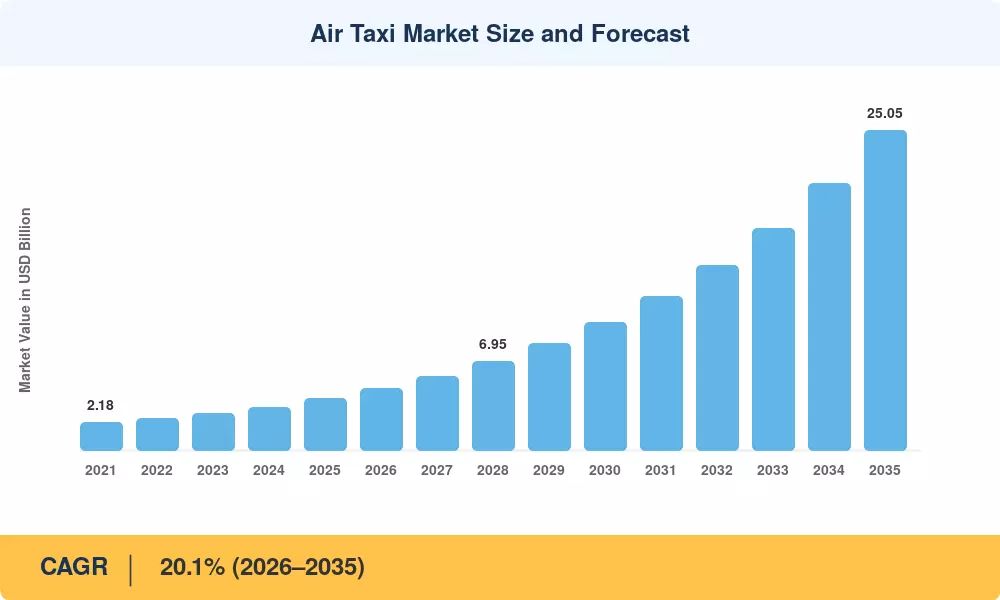
Air Taxi Market to Reach USD 25.05 Billion by 2035, Growing at 20.1% CAGR
Air Taxi Market
North America accounted for 48.3% of the Air Taxi Market in 2025, with Europe registering the highest regional CAGR.
NEW YORK, NY, UNITED STATES, August 31, 2026 /EINPresswire.com/ -- According to Market Research Future, the Air Taxi Market is projected to grow from USD 4.82 Billion in 2026 to USD 25.05 Billion by 2035, registering a 20.1% CAGR during 2026 to 2035, driven by Advancements in electric vertical takeoff and landing technology. This extraordinary growth reflects the dawn of a new era in urban transportation, where air taxis are emerging as a transformative solution to escalating urban congestion, offering faster, more direct travel options that bypass ground-level traffic constraints.Market Overview
Air taxis, also known as urban air mobility vehicles, represent a paradigm shift in personal and commercial transportation, utilizing electric vertical takeoff and landing aircraft to transport passengers and cargo at lower altitudes within urban and suburban areas. These vehicles encompass a diverse range of configurations including multicopter, lift-plus-cruise, tilt-rotor, and tilt-wing designs, with passenger capacities ranging from one to over six seats. The Urban Air Mobility Market serves as the broader ecosystem encompassing air taxis, vertiports, and air traffic management systems, while the Electric Vehicle (EVs) Market provides the foundational battery and electric propulsion technologies that enable sustainable aviation.
The key growth drivers propelling this market expansion include the severe traffic congestion plaguing metropolitan areas worldwide, which has created urgent demand for alternative transportation solutions. Rapid urbanization is intensifying mobility challenges, with 68% of the global population projected to reside in cities by 2050, making innovative solutions like air taxis increasingly essential. Advancements in battery technology, electric propulsion, and autonomous flight systems have made air taxis technically viable and economically feasible. Government initiatives supporting smart city development and sustainable transportation are accelerating UAM adoption, with regulatory agencies in the United States, Germany, China, and Japan actively establishing frameworks for airworthiness, safety, and airspace integration.
Technological developments are reshaping the air taxi landscape at an accelerating pace. The rise of electric aviation, combined with significant improvements in battery energy density, has made UAM more viable and environmentally friendly. Distributed electric propulsion systems enable quiet operation essential for urban environments, while advancements in artificial intelligence and sensor fusion are rapidly improving the safety of unmanned flight. Autonomous and optionally piloted aircraft configurations are gaining traction, with optionally piloted air taxis currently leading revenue contribution due to their operational flexibility and scalability.
Market Segmentation
The air taxi market is segmented based on mode of operation, propulsion type, passenger capacity, range, end-use, lift technology, and region to provide comprehensive insights into the industry landscape.
By Mode of Operation: The market is categorized into Piloted and Autonomous/Remotely Piloted operations. Optionally piloted air taxis currently contribute the largest share of revenue, leveraging flexibility in operation and reduced pilot dependency for certain routes, attracting premium customers and corporate contracts due to operational efficiency and scalability. Fully piloted air taxis continue to expand steadily in revenue due to regulatory mandates and urban integration strategies, while autonomous operations represent the long-term vision for economically viable mass-scale transportation.
By Propulsion Type: The market covers Battery-Electric, Hybrid, Turboshaft, and Hydrogen Fuel-Cell systems. Battery-electric propulsion dominates the segment, driven by zero-emission requirements and rapid advancements in lithium-ion battery technology. Hybrid systems offer extended range for intercity operations, while hydrogen fuel-cell technology is emerging as a promising solution for longer-range applications, aligning with industry net-zero carbon targets.
By Passenger Capacity: The market serves 1 to 2 Seats, 3 to 4 Seats, 5 to 6 Seats, and More than 6 Seats categories. One-passenger capacity air taxis appeal to individuals seeking personal convenience and privacy, targeted toward high-net-worth individuals and executives. Four-passenger configurations appeal to families or small groups, offering a balance between personal convenience and group functionality. More than six-passenger capacity air taxis are suited for commercial applications such as shuttle services between airports, hotels, and tourist destinations.
By Range: The market primarily serves Intracity (≤300 km) applications, with short-range routes (less than 50 km) currently accounting for the largest share due to strong demand for intra-city travel and alignment with current eVTOL battery constraints.
By End-Use: The market covers Airport Shuttle, Corporate Shuttle, Tourism & Charter, Emergency Medical, and On-Demand Air Taxi applications. Commercial fleet operators represent the largest end-user segment, with partnerships between operators and OEMs rising throughout the industry. Cargo logistics is emerging as a significant use case, while airport connectivity is attracting attention in major cities.
By Lift Technology: The market encompasses Multicopter, Lift-plus-Cruise, Tilt-Rotor, and Tilt-Wing designs. Multicopter air taxis currently exhibit clear market dominance, offering solutions to urban traffic congestion by enabling direct point-to-point travel while improvements in battery life and energy density are enhancing operational range and efficiency.
By Region: The market analysis covers North America, Europe, South America, Asia Pacific, and the Middle East and Africa.
🛒 You can buy this market report at:
https://www.marketresearchfuture.com/checkout?currency=one_user-USD&report_id=13981
Regional Analysis
North America currently dominates the global air taxi market, supported by a robust ecosystem of aerospace giants, a high concentration of tech-savvy early adopters, and proactive involvement from the Federal Aviation Administration in establishing certification frameworks. The presence of major players like Joby Aviation and Archer Aviation, combined with substantial military and private investment, ensures that the United States remains the primary hub for air taxi development. Existing infrastructure in major American cities provides ideal testing grounds for early commercial routes, while the FAA's Advanced Air Mobility National Campaign sets planning frameworks across aircraft, airspace, operations, infrastructure, and community engagement.
Asia Pacific is anticipated to exhibit the highest CAGR, driven by rapid urbanization and urgent need for innovative mobility solutions to combat extreme road congestion in nations such as China, India, and South Korea. Governments in this region are aggressively funding urban air mobility projects as part of national infrastructure agendas, supported by the rise of local eVTOL manufacturers. China, Japan, and South Korea are actively supporting UAM through pilot programs, with regulatory frameworks becoming increasingly favorable in many areas. Singapore and Thailand are emerging as early adoption hubs, benefiting from strong government support and investment in smart city infrastructure.
Europe maintains a strong presence in the air taxi market due to regulatory frameworks supporting sustainable air mobility and pilot programs in metropolitan areas. The European Union's stringent emission reduction targets and commitment to net-zero carbon by 2050 create a favorable policy environment for electric aviation. Germany, France, and the United Kingdom are leading the region with significant investments in eVTOL development and vertiport infrastructure. The region benefits from strong collaboration between aerospace manufacturers, technology providers, and regulatory authorities, accelerating commercialization pathways.
South America and the Middle East and Africa represent emerging markets with developing potential. Latin American countries are gradually adopting UAM technologies, supported by improving economic conditions and urbanization trends. The Middle East, particularly the UAE and Saudi Arabia, is showing increasing interest in air mobility as part of economic diversification and smart city development, with Dubai aiming to become a pioneer in autonomous air taxi services.
Competitive Landscape and Key Players
The air taxi market is highly competitive, featuring a mix of established aerospace giants, innovative startups, and automotive manufacturers. The competitive landscape is characterized by technological innovation, strategic partnerships, and infrastructure development.
Key players operating in this market include Joby Aviation, Archer Aviation, Volocopter GmbH, EHang Holdings Ltd., Beta Technologies, Vertical Aerospace Group Ltd., Eve Air Mobility, Supernal (Hyundai Motor Group), Airbus SE, Bell Textron Inc., Wisk Aero LLC, Jaunt Air Mobility Corporation, Pipistrel d.o.o., SkyDrive Inc., and Lilium GmbH. These industry leaders are investing heavily in research and development to create certified eVTOL aircraft capable of safe, efficient urban operations.
Strategic developments are reshaping the competitive landscape. In December 2025, Joby Aviation announced a partnership with Metropolis to develop 25 vertiports across the United States, advancing infrastructure critical for commercial air taxi operations. In the same month, Archer Aviation announced its partnership with multiple U.S. cities to launch initial air taxi trials under the federal eVTOL Integration Pilot Program, aligned with the Department of Transportation's Advanced Air Mobility National Strategy. Eve Air Mobility completed the successful first flight of its full-scale eVTOL prototype, a key step toward future air taxi services.
Innovation and technology initiatives are accelerating across the industry. Companies are developing autonomous flight systems, advanced battery technologies, and vertiport infrastructure to support commercial deployment. Partnerships between OEMs, infrastructure providers, and mobility operators are strengthening the UAM ecosystem and accelerating commercialization. The growing focus on sustainable aviation, including electric and hydrogen propulsion, aligns with global efforts to achieve net-zero emissions by 2050.
Latest Industry News and Developments
Recent industry developments highlight the dynamic nature of the air taxi market. In November 2024, Toyota and Joby Aviation successfully conducted their inaugural air taxi flight in Japan, demonstrating the international expansion of air taxi capabilities and the growing global interest in UAM solutions.
In December 2025, Joby Aviation announced a strategic partnership with Metropolis to develop 25 vertiports across the United States, building the physical infrastructure essential for commercial air taxi networks. Archer Aviation simultaneously revealed plans to partner with multiple U.S. cities for initial air taxi trials under the federal eVTOL Integration Pilot Program, signaling strong regulatory support and public-private collaboration.
Eve Air Mobility achieved a significant milestone in December 2025 with the successful first flight of its full-scale eVTOL prototype, representing a critical step toward commercial certification and service deployment. These developments underscore the accelerating momentum toward commercial air taxi operations, with 2026 and 2027 expected to see numerous certification milestones and route demonstrations.
Market Challenges and Opportunities
The air taxi market faces several key challenges that could impact growth trajectories. The development of comprehensive regulatory frameworks for airworthiness, safety, and airspace integration remains a complex, time-consuming process requiring international coordination. High infrastructure costs for vertiports, charging stations, and air traffic management systems represent significant barriers to rapid deployment. Public acceptance and community integration remain critical considerations, with noise concerns, safety perceptions, and urban integration requiring careful management.
Battery technology limitations, including range constraints and charging times, currently restrict operational capabilities. Autonomous flight systems require further development and validation to achieve the reliability and safety levels necessary for mass-market adoption. Interoperability between different aircraft types, infrastructure providers, and air traffic systems presents technical and operational challenges.
Emerging opportunities are abundant in the evolving mobility landscape. The integration of air taxis with existing transportation networks, including ride-hailing platforms and public transit systems, presents significant growth potential for comprehensive mobility solutions. Emergency medical services applications are expanding, with air taxis offering rapid response capabilities in urban environments. Cargo and logistics applications are emerging as significant use cases, leveraging the speed and efficiency of eVTOL aircraft for time-sensitive deliveries. Government support through grants, subsidies, and favorable regulations is accelerating development and deployment across major economies.
Future growth potential remains exceptionally strong, driven by the ongoing transformation of urban mobility and the increasing viability of electric aviation. As battery technology continues to advance, charging infrastructure expands, and regulatory frameworks mature, air taxis will become increasingly accessible and affordable across global markets. Manufacturers that embrace innovation, build resilient supply chains, and develop comprehensive mobility ecosystems will capture value in the rapidly evolving air transportation landscape.
To explore more market insights, visit us at:
https://www.marketresearchfuture.com/reports/air-taxi-market-13981
Final Market Summary
The air taxi market is poised for extraordinary growth, driven by technological advancement, regulatory support, and the escalating demand for efficient urban transportation. The market's trajectory from USD 4.82 Billion in 2026 to USD 25.05 Billion by 2035 reflects the transformative potential of electric vertical takeoff and landing aircraft to revolutionize urban mobility and reshape how people and goods move through cities.
The long-term industry potential remains exceptionally bright, with advancements in electric propulsion, autonomous flight, and battery technology continuing to expand the capabilities and applications of air taxis. The convergence of air mobility with broader smart city ecosystems, including connected infrastructure, renewable energy, and digital platforms, is creating comprehensive solutions that serve diverse urban needs.
Key factors expected to influence future development include the pace of regulatory certification, advancements in battery technology and energy density, and the evolution of urban infrastructure. The development of vertiport networks and air traffic management systems will enable scalable, safe operations across metropolitan areas. As urban populations grow and congestion intensifies, the demand for efficient, sustainable air transportation will continue to rise, ensuring sustained innovation and growth throughout the forecast period and beyond.
More Related Reports from MRFR Library:
China Automotive Tire Market : https://www.marketresearchfuture.com/reports/china-automotive-tire-market-54692
Japan Automotive Wiring Harness Market : https://www.marketresearchfuture.com/reports/japan-automotive-wiring-harness-market-54697
Germany Automotive OEM Market : https://www.marketresearchfuture.com/reports/germany-automotive-oem-market-56673
Japan Automotive OEM Market : https://www.marketresearchfuture.com/reports/japan-automotive-oem-market-56674
France Boat Rental Market : https://www.marketresearchfuture.com/reports/france-boat-rental-market-56699
Europe Electric Mobility Market : https://www.marketresearchfuture.com/reports/europe-electric-mobility-market-56708
Germany Automotive Retail Market : https://www.marketresearchfuture.com/reports/germany-automotive-retail-market-56711
Europe Automotive Retail Market : https://www.marketresearchfuture.com/reports/europe-automotive-retail-market-56713
China Automotive Retail Market : https://www.marketresearchfuture.com/reports/china-automotive-retail-market-56715
India Automotive Finance Market : https://www.marketresearchfuture.com/reports/india-automotive-finance-market-56721
Market Research Future
Market Research Future
+1 855-661-4441
email us here
Legal Disclaimer:
EIN Presswire provides this news content "as is" without warranty of any kind. We do not accept any responsibility or liability for the accuracy, content, images, videos, licenses, completeness, legality, or reliability of the information contained in this article. If you have any complaints or copyright issues related to this article, kindly contact the author above.
