
Water-based Coatings Market at 5.09% CAGR to Grow from USD 63.21 Billion in 2026 to USD 100.42 Billion by 2035
Water-based coatings Market (2026 - 2035)
Asia-Pacific led the Water-based Coatings Market with 45.1% revenue share in 2025
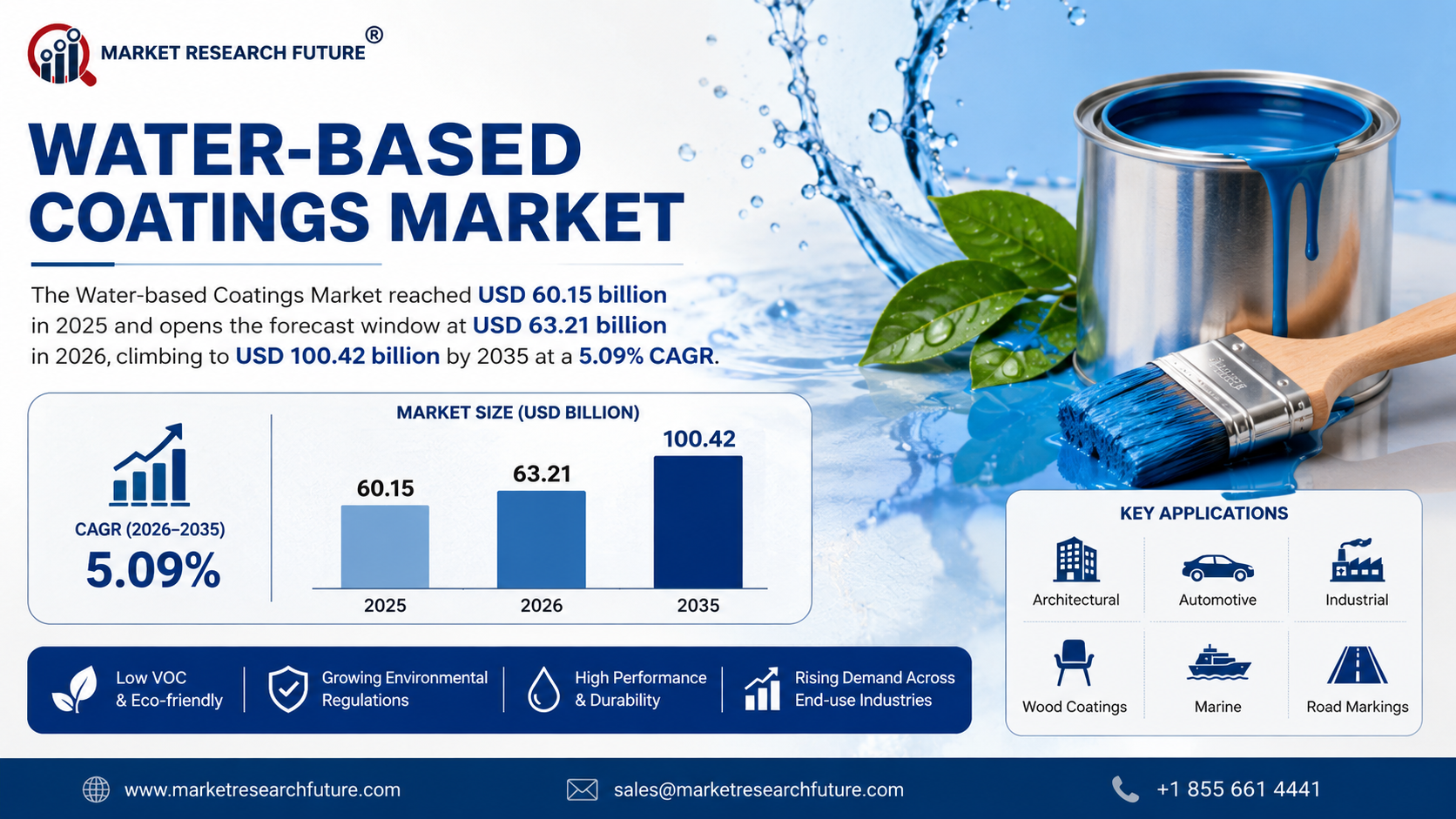
FL, UNITED STATES, September 4, 2026 /EINPresswire.com/ -- The global Water-Based Coatings Market is expanding as manufacturers, construction companies, automotive producers, and industrial users increasingly shift toward lower-emission coating technologies. According to the latest Market Research Future Water-Based Coatings Market report, the market reached USD 60.15 billion in 2025 and is projected to climb to USD 100.42 billion by 2035, registering a 5.09% CAGR from 2026 to 2035. The market is expected to reach approximately USD 63.21 billion in 2026.Water-based coatings are becoming an important alternative to traditional solvent-borne systems because of tightening VOC regulations, infrastructure investment, changing automotive coating requirements, and growing demand for sustainable products. Beyond conventional architectural paints, manufacturers are developing waterborne polyurethane, acrylic, epoxy, bio-attributed, PFAS-free, and specialty formulations for increasingly demanding applications.
VOC Regulations Accelerate Water-Based Coatings Adoption
Tightening restrictions on volatile organic compound emissions are one of the strongest forces shaping the market. Governments and regulatory agencies are imposing increasingly stringent limits on solvent emissions, encouraging coating manufacturers to reformulate products and customers to transition toward waterborne technologies.
The MRFR analysis identifies VOC regulation tightening as the largest driver impact, contributing approximately 1.30 percentage points to CAGR momentum. Regulatory changes in Europe and North America are particularly influential because they directly affect formulation requirements and industrial coating operations.
The European Union's Industrial Emissions Directive recast and evolving regional VOC requirements are accelerating investment in lower-emission coating systems. In the United States, state-level regulations are also creating a gradual conversion pathway from solvent-based products to waterborne alternatives.
This regulatory environment provides coating manufacturers with a strong incentive to develop products that deliver comparable durability, appearance, adhesion, and application performance while reducing emissions.
Infrastructure and Construction Spending Drive Market Expansion
Infrastructure development and construction activity represent another major source of demand. The MRFR report estimates that infrastructure and construction spending contributes approximately 1.15 percentage points to CAGR momentum, particularly across Asia-Pacific and North America.
Water-based coatings are widely used in architectural finishes, structural components, infrastructure maintenance, and industrial facilities. New construction creates demand for decorative and protective coatings, while ageing infrastructure generates recurring requirements for recoating and maintenance.
Bridge, rail, steel-structure, commercial-building, and residential projects are increasingly incorporating lower-emission coating specifications. This creates opportunities for suppliers capable of offering waterborne systems that meet durability and environmental requirements.
Acrylic Resin Maintains Market Leadership
By resin type, acrylic resins accounted for 75.4% of Water-Based Coatings Market share in 2025, making acrylic the dominant resin category. Its position is supported by established dispersion technology, colour stability, cost efficiency, and extensive use in architectural and general industrial applications.
Acrylic systems are widely used for decorative coatings and numerous industrial applications where weatherability and appearance are important. Their mature supply chain also supports broad adoption across developed and emerging markets.
However, polyurethane is emerging as the fastest-growing major resin category. The MRFR report projects water-based polyurethane resin to grow at a 6.28% CAGR through 2035. Polyurethane systems are gaining attention because they can provide improved hardness, flexibility, and resistance characteristics for applications where conventional acrylic systems may have limitations.
Epoxy dispersions also hold an important position in technically demanding applications. The segment generated approximately USD 5.84 billion in 2025, supported by protective, marine, and flooring applications.
Requred Free Sample Copy: https://www.marketresearchfuture.com/sample_request/5742
Automotive Conversion Creates a High-Growth Opportunity
Automotive applications are becoming one of the most important growth areas for water-based coatings. The market report projects the automotive end-use segment to expand at a 6.31% CAGR from 2026 to 2035, making it the fastest-growing major end-user industry.
Automotive OEMs have increasingly adopted waterborne basecoat technologies as manufacturers seek to reduce paint-shop emissions. Refinish operations represent an additional opportunity because independent collision centers in some markets continue to rely heavily on solvent-based systems.
North America is particularly attractive for automotive refinish conversion. The report identifies a substantial addressable conversion opportunity as state and regional VOC requirements increasingly encourage body shops to transition toward waterborne technologies.
Waterborne coating suppliers can benefit by offering complete conversion packages that combine coatings with application support, technician training, colour-management tools, and equipment upgrades.
Building and Construction Remains the Largest End-User Industry
Building and construction represented 38.6% of market demand in 2025, maintaining its position as the largest end-user industry. Housing construction, commercial development, renovation, and infrastructure maintenance all contribute to this demand.
Architectural and decorative applications are particularly important because coatings are required across residential and commercial buildings. Repainting cycles can also provide recurring demand independent of new construction.
The growth of sustainable buildings is strengthening the position of low-emission coating systems. Developers and building owners increasingly consider VOC content, environmental documentation, and lifecycle performance when selecting materials.
In emerging economies, expanding housing stock and rising urban populations create additional volume opportunities for water-based architectural coatings.
Architectural and Decorative Applications Lead
By application, Architectural and Decorative coatings accounted for 41.7% of market share in 2025, making it the largest application category. Residential and commercial repainting cycles remain the primary demand drivers.
Industrial OEM finishing is another major application, generating approximately USD 15.63 billion in 2025. Factory-applied coatings are used across machinery, appliances, metal products, and other manufactured goods.
Automotive refinish is projected to grow at 6.11% CAGR through 2035, while Specialty and Functional applications are expected to expand at 5.97% CAGR. These specialty applications include emerging requirements associated with electric vehicles, antimicrobial coatings, and barrier systems.
The diversification of applications means future growth will increasingly come from technically demanding coatings rather than only conventional decorative paints.
Asia-Pacific Dominates the Global Market
Asia-Pacific held 45.1% of global Water-Based Coatings Market revenue in 2025, making it the leading regional market. The region is also projected to remain the fastest-growing major market, with a 5.51% CAGR from 2026 to 2035.
China represents a major share of the regional market because of its extensive coatings manufacturing capacity, industrial base, construction activity, and growing enforcement of VOC standards.
India is another important growth market, with the report projecting a 6.44% CAGR. Residential construction and the already high penetration of waterborne decorative coatings are supporting continued expansion.
Japan and South Korea provide opportunities in automotive, electronics, shipbuilding, and industrial finishing, while ASEAN markets benefit from manufacturing relocation and construction investment.
Europe Advances Through Regulatory Pressure
Europe remains an important market because environmental regulations strongly influence coating specifications. The region is projected to grow at a 4.72% CAGR from 2026 to 2035.
The European market is being shaped by tighter emissions requirements, environmental product declarations, sustainable procurement, and increasing interest in bio-attributed resins.
Germany has a particularly strong position because of its automotive manufacturing base, while France benefits from public-building renovation programs. Nordic countries are also becoming important testing grounds for waterborne marine and protective coating technologies.
European manufacturers are increasingly competing not only on coating performance but also on environmental documentation and lifecycle transparency.
North America Focuses on Refinish and Infrastructure
North America generated approximately USD 12.87 billion in 2025. The region's market is supported by automotive refinish conversion, infrastructure maintenance, protective coatings, and increasingly stringent state-level VOC regulations.
The United States represents the majority of regional demand, while Canada benefits from infrastructure maintenance programs. Mexico is projected to grow at a 5.82% CAGR, supported partly by automotive manufacturing relocation and nearshoring.
Infrastructure recoating is particularly attractive because bridges, rail systems, industrial structures, and other assets require periodic maintenance. Waterborne protective systems that meet required durability standards can therefore create recurring demand.
Buy Now: https://www.marketresearchfuture.com/checkout?currency=one_user-USD&report_id=5742
Bio-Based and PFAS-Free Formulations Gain Momentum
Sustainability is moving beyond VOC reduction toward broader formulation changes. Bio-based resins, PFAS-free additives, recycled-content binders, and improved environmental documentation are becoming increasingly relevant.
The MRFR report identifies bio-based and PFAS-free resin innovation as contributing approximately 0.70 percentage points to CAGR momentum.
PFAS restrictions are encouraging formulators to replace fluorinated additives used for wetting, levelling, and other performance functions. This is creating a substantial reformulation opportunity for suppliers capable of providing non-fluorinated alternatives without sacrificing coating performance.
Bio-attributed acrylic and polyurethane dispersions are also gaining attention as companies attempt to reduce the carbon intensity of their product portfolios.
Electric Vehicles Create New Coating Requirements
The expansion of electric vehicles is opening new application areas for water-based coatings. EV battery packs, enclosures, electrical components, and other systems require coating properties that extend beyond conventional automotive appearance and corrosion protection.
The report highlights EV-related specialty and functional coatings as an emerging opportunity. Waterborne systems can potentially be developed for applications requiring dielectric, thermal-management, flame-retardant, or barrier characteristics.
Automotive electrification therefore represents both a substitution opportunity and a source of entirely new coating demand.
Suppliers that qualify products early with automotive manufacturers can benefit from longer specification cycles and integration into future vehicle platforms.
Digital Colour Management Supports Industry Innovation
Digital technology is becoming increasingly important in coating development and application. Spectrophotometer-connected colour platforms, cloud-based formulation databases, automated compliance documentation, and predictive formulation tools can improve manufacturing and application efficiency.
The latest MRFR report highlights formulation intelligence and predictive colour systems as important future developments. Machine-learning tools can help manufacturers screen resin-additive combinations faster and improve colour consistency.
Digital services can also strengthen customer relationships. Suppliers that combine coatings with colour-management software, specification platforms, technical support, and application data can create additional value beyond the physical product.
Recoating Ageing Infrastructure Offers Recurring Demand
Maintenance and recoating of existing infrastructure represent an attractive opportunity because demand is less dependent on new construction cycles.
Bridges, rail infrastructure, industrial facilities, marine assets, and steel structures require periodic protective treatment. As owners seek lower-emission maintenance solutions, qualified waterborne protective coatings can increasingly compete with traditional solvent-borne systems.
This creates a recurring revenue opportunity for manufacturers with products capable of meeting stringent corrosion-protection and durability specifications.
Challenges Facing the Water-Based Coatings Market
Despite strong growth prospects, water-based coatings face several technical and commercial challenges.
Acrylic monomer price volatility is one important concern. Feedstock fluctuations can place pressure on manufacturers, particularly in decorative applications where acrylic dispersions account for a significant portion of formulated costs. MRFR estimates approximately 0.65 percentage points of directional CAGR drag from acrylic monomer volatility.
Performance gaps in extreme environments also remain a challenge. Some offshore immersion, high-temperature, and aggressive chemical applications continue to favor solvent-borne technologies.
Waterborne coatings can also be sensitive to humidity and temperature during application. These factors may narrow application windows and increase the risk of rework in challenging climates.
Finally, converting industrial coating lines can require significant capital investment because facilities may need humidity control, corrosion-resistant circulation systems, and longer flash-off zones.
Report Summary: https://www.marketresearchfuture.com/reports/water-based-coatings-market-5742
Competitive Landscape
The global Water-Based Coatings Market is fragmented, with major multinational companies competing alongside regional specialists. The latest MRFR report identifies PPG Industries, AkzoNobel, BASF, Sherwin-Williams, Nippon Paint, Asian Paints, Axalta Coating Systems, Kansai Paint, RPM International, Jotun, and Hempel among the key companies.
PPG maintains a strong position across automotive OEM, refinish, and protective coatings. AkzoNobel has a significant presence in decorative and marine applications, while BASF benefits from its upstream resin and dispersion capabilities.
Asian Paints has an important position in India's decorative market, while Nippon Paint benefits from its strong Asia-Pacific distribution network. Other companies are differentiating themselves through specialty protective coatings, marine applications, digital colour tools, and sustainability-focused formulations.
Future competition is likely to increasingly depend on formulation performance, supply reliability, environmental documentation, and the ability to support customers through technology transitions.
Related Report
Water-Based Resins Market https://www.marketresearchfuture.com/reports/water-based-resins-market-6357
Water-Based Adhesive Market https://www.marketresearchfuture.com/reports/water-based-adhesive-market-6987
Anti-Viral Coating Market https://www.marketresearchfuture.com/reports/anti-viral-coating-market-35039
Automotive Refinish Coatings Market https://www.marketresearchfuture.com/reports/automotive-refinish-coatings-market-6670
resins in paints coating market https://www.marketresearchfuture.com/reports/resins-in-paints-coating-market-37978
wood coating resin market https://www.marketresearchfuture.com/reports/wood-coating-resin-market-41257
Market Research Future
Market Research Future
+1 855-661-4441
email us here
Legal Disclaimer:
EIN Presswire provides this news content "as is" without warranty of any kind. We do not accept any responsibility or liability for the accuracy, content, images, videos, licenses, completeness, legality, or reliability of the information contained in this article. If you have any complaints or copyright issues related to this article, kindly contact the author above.
