

Analytical Instrumentation Market to reach USD 103.33 Billion by 2035 at 7.28% CAGR
Analytical Instrumentation Market (2026 - 2035)
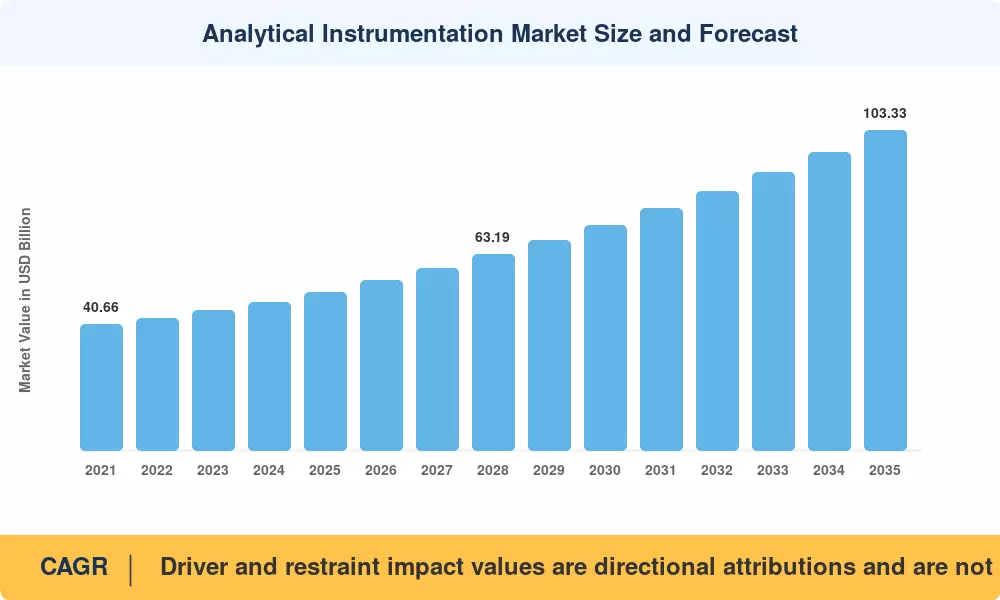
Analytical Instrumentation Market to Expand from USD 51.18 Bn in 2025 to $ 103.33 Bn by 2035— Tightening Contaminant Regulations, Semiconductor Metrology Demand
NY, CA, UNITED STATES, September 7, 2026 /EINPresswire.com/ -- As per Market Research Future, the global Analytical Instrumentation Market size is projected to reach USD 103.33 Billion by 2035 from USD 51.18 Billion in 2025, at a CAGR of 7.28% during the forecast period 2026–2035. The market base was estimated at approximately USD 47.5 Billion in 2024.The 7.28% CAGR—anchored by structural shifts in quality control and regulatory compliance—is propelled by three converging forces: tightening global contaminant and impurity thresholds, with the U.S. Environmental Protection Agency's April 2024 PFAS drinking-water rule setting enforceable limits at 4 parts per trillion, driving demand for high-end mass spectrometry and chromatography systems; advancements in sub-3 nanometre semiconductor metrology, fueled by the CHIPS and Science Act's roughly USD 52.7 billion commitment to domestic semiconductor capacity, where metrology and inspection account for 12–14% of fab tool budgets; and the formal adoption of ICH Q14 and revised Q2(R2) guidelines in November 2023, legitimising real-time release testing and analytical procedure lifecycle management across pharmaceutical manufacturing.
Global analytical instrumentation vendors and regulatory bodies are amplifying this momentum. Thermo Fisher Scientific continues advancing its Orbitrap platform with the Astral mass spectrometer launch, resetting high-end sensitivity expectations. Agilent Technologies introduced the InfinityLab LC Series III platform with instrument intelligence diagnostics. The U.S. Environmental Protection Agency's PFAS rule affects roughly 66,000 public water systems, while SEMI predicts global fabrication equipment spending will surpass USD 128 billion by 2026. These forces are creating the regulatory infrastructure and industrial demand on which the Analytical Instrumentation Market depends.
Request A Free Sample:\nhttps://www.marketresearchfuture.com/sample_request/21857
Key Market Trends & Growth Drivers
Tightening Contaminant and Impurity Thresholds
The market is witnessing increasing demand driven by ever-stricter regulatory limits. The EPA's PFAS rule and EU Regulation 2023/915 on food contaminants are forcing laboratories to requalify procedures and invest in high-sensitivity mass spectrometry and chromatography systems. This trend indicates a shift from questioning whether a chemical is present to determining how little is present, with ICP-MS and LC-MS/MS purchase orders surging across accredited laboratories. Thermo Fisher Scientific continues advancing high-resolution mass spectrometry platforms to meet these evolving detection requirements.
Advancements in Semiconductor Metrology
Innovations in process control are becoming a hallmark of the industry. As defect budgets fall below 3 nanometres, inline particle-size and elemental analysis have become production-critical instead of merely diagnostic. Semiconductor and electronics buyers contributed approximately USD 7.47 billion in 2025 to the Analytical Instrumentation Market, with metrology demand concentrated in Taiwan, South Korea, and Arizona.
Pharmaceutical Real-Time Release Testing
The incorporation of process analytical technology into regulated manufacturing is gaining traction. ICH Q14 and Q2(R2) guidelines, adopted in November 2023, have made analytical procedure lifecycle management an explicit regulatory expectation. The FDA has reported that process analytical technology adopters cut batch release cycle times by 30–50%, justifying capital outlay on inline spectroscopy and driving pharmaceutical and biopharmaceuticals to account for 31.1% of 2025 revenue. Waters Corporation continues strengthening its regulated-pharma installed base through data-integrity-focused platform releases.
Cloud and AI-Enabled Laboratory Informatics
The integration of digital informatics into the industry is accelerating. Chromatography data systems, electronic lab notebook integration, and compliant cloud archiving carry gross margins well above hardware, with data-management software and services advancing at a 9.05% CAGR. Instrument vendors are increasingly monetising the data layer, reframing the market from a capital-equipment business into a recurring-revenue one. Agilent Technologies continues investing in OpenLab informatics and connected laboratory ecosystems.
Rising Demand for Portable and Field-Deployable Testing
The market is witnessing increasing demand for instruments that leave the laboratory entirely. Handheld Raman and portable XRF now deliver laboratory-grade answers at the wellhead, border post, and farm gate. Portable and handheld formats are growing at 8.0% CAGR, well above the platform average, as decentralised testing expands across environmental, agricultural, and forensic applications.
Ask for Customization:\nhttps://www.marketresearchfuture.com/ask_for_customize/21857
Market Segment Insights
BY PRODUCT TYPE
Mass Spectrometry: Largest segment with 27.3% share in 2025, driven by trace contaminant and biologics characterisation demands. Thermo Fisher Scientific continues expanding its Orbitrap platform through sustained product innovation.
Chromatography: Significant segment generating roughly USD 11.05 billion in 2025, remaining the volume backbone of the market and sustaining the largest consumables annuity in the sector.
Molecular Spectroscopy: Held 14.2% share in 2025, supporting inline process monitoring applications across pharmaceutical and chemical manufacturing.
Data Management Software and Services: Fastest-growing line, advancing at a 9.05% CAGR, carrying the highest margins and increasingly determining which hardware a laboratory can buy.
Elemental Spectroscopy: Fastest-growing hardware segment at 8.9% CAGR, driven by heavy-metal and battery materials analysis for EV supply chains.
BY END-USER INDUSTRY
Pharmaceuticals and Biopharmaceuticals: Largest segment with 31.1% share in 2025, due to GMP release testing and biologics characterisation requirements. Danaher continues driving operating-system-driven margin discipline across its analytical portfolio.
Semiconductor and Electronics: Significant segment contributing approximately USD 7.47 billion in 2025, driven by sub-3 nm process control demands and inline metrology requirements.
Environmental Testing Laboratories: Fastest-growing end-user segment at a 9.55% CAGR, propelled by PFAS, microplastics, and emerging-contaminant monitoring panels expanding faster than anticipated.
Food and Beverage Testing: Held 13.4% share in 2025, reflecting tightening food-safety enforcement globally under regulations such as EU 2023/915.
BY INSTRUMENT PORTABILITY
Benchtop and Floor-Standing: Dominant category with 52.8% share in 2025, serving centralised regulated laboratories with robust configurations.
Inline and Online Process Instruments: Significant segment valued at USD 11.57 billion in 2025, supporting continuous manufacturing control in pharmaceutical and chemical production.
Portable and Handheld: Fastest-growing category at 8.0% CAGR, appealing to field screening and incoming inspection applications across environmental and agricultural sectors.
BY SALES CHANNEL
Direct Sales: Largest channel with 58.0% share in 2025, governing high-value transactions through complex configurations and service bundling.
Distributors and System Integrators: Significant channel generating USD 16.63 billion in 2025, providing regional reach and mid-tier account access.
eCommerce Marketplaces: Fastest-growing channel at 7.95% CAGR, capturing the consumables and standardised unit reorder economy among tech-savvy procurement teams.
Read Detailed Insights:\nhttps://www.marketresearchfuture.com/reports/analytical-instrumentation-market-21857
Regional Outlook
North America — Market Leader in Innovation
North America leads with over 37.0% of global revenue in 2025, generating around USD 18.94 Billion. The region's growth is driven by biopharmaceutical QC, PFAS testing mandates affecting roughly 66,000 public water systems, and semiconductor fab construction in Arizona, Texas, and Ohio. The United States anchors the region through sheer regulatory density, while Canada benefits from cannabis and environmental testing at approximately USD 3.05 billion, and Mexico grows at 7.6% CAGR through nearshored medical-device and food exports. The competitive landscape is characterised by continuous innovation and strategic partnerships among leading analytical instrumentation vendors.
Europe — Second Largest Market
Europe held 26.8% share in 2025, representing the second-largest regional market. The region benefits from food-safety enforcement under Regulation 2023/915, REACH compliance, and the Chemicals Strategy for Sustainability. Germany carries the largest single-country load at 24.6% of regional revenue through its chemical cluster and automotive materials laboratories, while the UK sustains instrument density at approximately USD 3.02 billion through contract research organisations. France, Italy, and the Nordic countries contribute significantly across food safety, agri-food authenticity, and environmental monitoring applications.
Asia-Pacific — Rapidly Growing Market Segment
The Asia-Pacific region is the growth engine at an 8.35% CAGR through 2035. Growth is driven by semiconductor fabs in Taiwan and South Korea, battery gigafactory quality control, and generic pharmaceutical export compliance in India at 9.6% CAGR. China's domestic instrumentation push has produced credible local ICP-MS and LC vendors, compressing prices while expanding total units. Japan contributes approximately USD 2.55 billion through materials science and semiconductor chemicals. The region is expected to narrow the gap with North America sharply after 2030 as the market re-centres on Asian fab and battery corridors.
Middle East and Africa — Untapped Potential
The MEA region holds around 4.5% of the global share, generating approximately USD 2.30 billion in 2025. Gulf demand runs through downstream petrochemical expansion and Saudi Vision 2030 funding for new research institutes and national testing centres. South Africa contributes approximately USD 0.44 billion through mining assay and pharmaceutical QC. Africa's trajectory is shaped by continental vaccine manufacturing ambitions and expanding ISO 17025 accreditation, creating first-generation laboratory infrastructure where none existed, favouring mid-tier and portable formats.
Competitive Landscape and Recent Developments
The analytical instrumentation market is characterised by intense competition and steady growth, driven by tightening regulation and industrial quality demands. The global industry appears moderately consolidated, with several key players exerting significant influence.
KEY COMPANIES AND RECENT MILESTONES
Thermo Fisher Scientific (US): Holds an estimated 14–17% revenue share, offering the broadest full-line platform including Orbitrap MS, ICP-MS, chromatography, and Chromeleon CDS. In June 2023, launched the Orbitrap Astral mass spectrometer, materially raising proteomics throughput and resetting high-end sensitivity expectations across the market.
Agilent Technologies (US): Holds an estimated 10–13% revenue share, with strong pharma and applied-market channel depth across LC, GC, LC-MS, ICP-MS, and OpenLab informatics. In March 2024, introduced the InfinityLab LC Series III platform with instrument intelligence diagnostics aimed at reducing unplanned laboratory downtime.
Danaher (US) (August 2025): Holds an estimated 8–11% revenue share through its SCIEX and Beckman Coulter subsidiaries, specialising in quadrupole and TOF MS and particle characterisation. Continues driving operating-system-driven margin discipline across its analytical portfolio.
Bruker Corporation (US) (May 2024): Holds an estimated 5–7% revenue share, with leadership in high-field magnetic resonance, NMR, FT-IR, XRF, and MALDI. Closed its acquisition of NanoString Technologies' assets, extending spatial biology capability alongside its core spectroscopy portfolio.
Waters Corporation (US) (October 2023): Holds an estimated 4–6% revenue share, with a deep regulated-pharma installed base built on UPLC, Alliance iS, mass detection, and Empower informatics. Released the Alliance iS HPLC system with built-in error-prevention features targeted at QC laboratories under data-integrity scrutiny.
Shimadzu Corporation (JP): Holds an estimated 4–6% revenue share, serving as a price-performance leader across Asia-Pacific in GC-MS, HPLC, UV-Vis, and testing machines.
Other Key Players: Revvity (US), Mettler-Toledo International (CH), HORIBA Ltd. (JP), JEOL Ltd. (JP), Oxford Instruments (GB).
Future Outlook: 2026–2035
The Analytical Instrumentation Market is projected to reach USD 103.33 billion by 2035, growing at a CAGR of 7.28%, driven by tightening contaminant regulations, semiconductor metrology demands, and pharmaceutical real-time release testing adoption.
New opportunities lie in:
Expansion into emerging markets with tailored mid-tier and portable analytical platforms
Development of AI-driven laboratory informatics and autonomous experimentation loops
Investment in battery and critical-minerals characterisation for EV supply chains
Data monetisation and outcome-based service contracts transforming vendor revenue models
Decentralised and field-portable testing solutions for environmental and agricultural applications
By 2035, the Analytical Instrumentation Market is expected to achieve substantial growth and innovation, with software and services representing an increasingly strategic prize.
More Related Research Insights:
https://www.marketresearchfuture.com/fr/reports/ayurveda-market-6166
https://www.marketresearchfuture.com/fr/reports/medical-devices-market-2869
https://www.marketresearchfuture.com/ja/reports/medical-devices-market-2869
https://www.marketresearchfuture.com/de/reports/medical-devices-market-2869
https://www.marketresearchfuture.com/es/reports/medical-devices-market-2869
https://www.marketresearchfuture.com/zh-cn/reports/medical-devices-market-2869
https://www.marketresearchfuture.com/ko/reports/medical-devices-market-2869
https://www.marketresearchfuture.com/fr/reports/herbal-medicine-market-3250
https://www.marketresearchfuture.com/ja/reports/herbal-medicine-market-3250
https://www.marketresearchfuture.com/de/reports/herbal-medicine-market-3250
Market Research Future
Market Research Future
+1 855-661-4441
email us here
Legal Disclaimer:
EIN Presswire provides this news content "as is" without warranty of any kind. We do not accept any responsibility or liability for the accuracy, content, images, videos, licenses, completeness, legality, or reliability of the information contained in this article. If you have any complaints or copyright issues related to this article, kindly contact the author above.
